Historical Fiction — Literature

Browse Literature tagged as “Historical Fiction”: a curated horror catalog with titles, synopses and related links.

28 Results

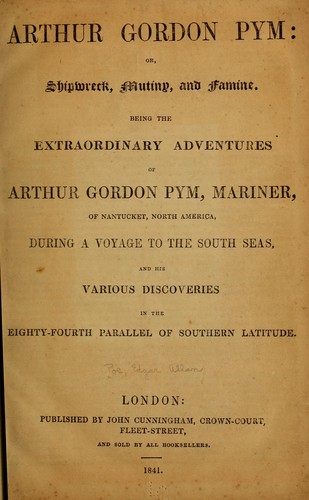
The Narrative of Arthur Gordon Pym
The Narrative of Arthur Gordon PymFrom the book:UPON my return to the United States a few months ago, after the extraordinary series of adventure in the South Seas and elsewhere, of which an account is given in the following pages, accident threw me into the society of several gentlemen in Richmond, Va., who felt deep interest in all matters relating to the regions I had visited, and who were constantly urging it upon me, as a duty, to give my narrative to the public. I had several reasons, however, for declining to do so, some of which were of a nature altogether private, and concern no person but myself, others not so much so. One consideration which deterred me was, that, having kept no journal during a greater portion of the time in which I was absent, I feared I should not be able to write, from mere memory, a statement so minute and connected as to have the appearance of that truth it would really possess, barring only the natural and unavoidable exaggeration to which all of us are prone when detailing events which have had powerful influence in exciting the imaginative faculties. Another reason was, that the incidents to be narrated were of a nature so positively marvellous, that, unsupported as my assertions must necessarily be (except by the evidence of a single individual, and he a half–breed Indian), I could only hope for belief among my family, and those of my friends who have had reason, through life, to put faith in my veracity– the probability being that the public at large would regard what I should put forth as merely an impudent and ingenious fiction. A distrust in my own abilities as a writer was, never- theless, one of the principal causes which prevented me from complying with the suggestion of my advisers.
Slashed Beauties
Slashed BeautiesA gothic feminist body horror in two timelines revolving around three Anatomical Venuses—ultrarealistic wax figures of women—that come to life at night to murder men who have wronged them. Seoul, present day. Antiques dealer Alys’s task is nearly complete. She has at last secured Elizabeth, the final anatomical Venus in a dangerously intertwined trio. Crafted in eighteenth-century London and modeled after real-life sex workers to entice male medical students to study female anatomy, these eerie wax figures, known as slashed beauties, carry unsavory lore. Legend has it that the figures are bewitched, and come to life at night to murder men who have wronged them. Now Alys embarks for England, where she knows what she must do: sever her cursed connection to the Venuses once and for all. London, 1763. Abandoned and penniless in Covent Garden, wide-eyed Eleanor and another young woman, Emily, are taken under the wing of beautiful and beguiling Elizabeth, one of the city’s most highly desired courtesans. But as Eleanor is seduced deeper into a web of money, materialism, and men, it seems that Elizabeth may not be the savior she appears to be. As past and present begin to intersect, it becomes clear that the women’s stories are linked in deeper, darker ways than it initially seems. And that the only method for Alys to end the witchcraft that binds her legacy is to gather all three models in one place and destroy them. The problem is, Elizabeth is not ready to burn. Far from it. Centuries on, she is determined to rise again, and she will obliterate anything standing in her path. Including Alys herself.
Blood Slaves
Blood SlavesFor fans of Ryan Coogler's Sinners and readers of Victor LaValle, Tananarive Due, Stephen Graham Jones, and Colson Whitehead’s The Underground Railroad, this ingenious reimagining of the vampire origin story set during the early days of American slavery blends alternate history with supernatural horror, as the last surviving member of an ancient African vampire tribe meets a slave desperate for freedom, and together, they lead an army of enslaved people in a cinematically blood-soaked battle for freedom and revenge. What if nobody ever freed the slaves…because they freed themselves – 150 years before the Civil War? In the Province of Carolina, 1710, freedom seems unattainable for Willie, for his beloved Gertie, and for their unborn child. They live, suffer, and toil under their brutal master, James “Big Jim” Barrow, whose grand plantation was built by the blood, sweat, and tears of the enslaved. To flee this hell on earth is be hunted and killed. Until one strange night Willie is offered a dark hope by Rafazi, an enigmatic slave with an irresistible and blood-chilling path to liberation. Hailing from the Kingdom of Ghana, Rafazi is the lone survivor of the Ramanga, an African vampire tribe rendered nearly extinct by plague. Rafazi has roamed the world for centuries with an undying desire to replenish the power that once defined his heritage. In Willie, Rafazi has found his first biddable subject to be turned and to help in a hungry revolt. And Willie desires nothing more than to free his people from malicious bondage. Whatever it takes. One by one, as an army of blood slaves thirsting for revenge is gathered, the headstrong Gertie fears that no good can come from the vampiric legacy that courses through Rafazi’s veins. Willie knows that only evil can fight evil. And when the woman he loves stands between the reemergence of the Ramanga and the justified slaughter of the oppressors, Willie must make an irreversible decision. Only one thing is certain: on the Barrow plantation, and beyond, blood will spill. Part historical drama, part supernatural horror, and part alternate history, Blood Slaves is an ingenuous and defiant new creation myth of the vampire, one rooted in both justice and the sometimes-violent means necessary to achieve it.

Grey Dog
Grey Dog“Gish’s prose is as sharp as a scalpel.” — Publishers Weekly, starred review “Grey Dog is a bewitching tale of the horrors of spinsterhood in the early 1900s, with madness and magic threaded through every sentence.” — Heather O’Neill, author of When We Lost Our Heads and Lullabies for Little Criminals A subversive literary horror novel that disrupts the tropes of women’s historical fiction with delusions, wild beasts, and the uncontainable power of female rage The year is 1901, and Ada Byrd — spinster, schoolmarm, amateur naturalist — accepts a teaching post in isolated Lowry Bridge, grateful for the chance to re-establish herself where no one knows her secrets. She develops friendships with her neighbors, explores the woods with her students, and begins to see a future in this tiny farming community. Her past — riddled with grief and shame — has never seemed so far away. But then, Ada begins to witness strange and grisly phenomena: a swarm of dying crickets, a self-mutilating rabbit, a malformed faun. She soon believes that something old and beastly — which she calls Grey Dog — is behind these visceral offerings, which both beckon and repel her. As her confusion deepens, her grip on what is real, what is delusion, and what is traumatic memory loosens, and Ada takes on the wildness of the woods, behaving erratically and pushing her newfound friends away. In the end, she is left with one question: What is the real horror? The Grey Dog, the uncontainable power of female rage, or Ada herself?
The Reformatory
The ReformatoryA gripping, page-turning novel set in Jim Crow Florida that follows Robert Stephens Jr. as he’s sent to a segregated reform school that is a chamber of terrors where he sees the horrors of racism and injustice, for the living, and the dead. Gracetown, Florida June 1950 Twelve-year-old Robbie Stephens, Jr., is sentenced to six months at the Gracetown School for Boys, a reformatory, for kicking the son of the largest landowner in town in defense of his older sister, Gloria. So begins Robbie’s journey further into the terrors of the Jim Crow South and the very real horror of the school they call The Reformatory. Robbie has a talent for seeing ghosts, or haints. But what was once a comfort to him after the loss of his mother has become a window to the truth of what happens at the reformatory. Boys forced to work to remediate their so-called crimes have gone missing, but the haints Robbie sees hint at worse things. Through his friends Redbone and Blue, Robbie is learning not just the rules but how to survive. Meanwhile, Gloria is rallying every family member and connection in Florida to find a way to get Robbie out before it’s too late. The Reformatory is a haunting work of historical fiction written as only American Book Award–winning author Tananarive Due could, by piecing together the life of the relative her family never spoke of and bringing his tragedy and those of so many others at the infamous Dozier School for Boys to the light in this riveting novel.
The Hacienda
The HaciendaMexican Gothic meets Rebecca in this debut supernatural suspense novel, set in the aftermath of the Mexican War of Independence, about a remote house, a sinister haunting, and the woman pulled into their clutches… During the overthrow of the Mexican government, Beatriz’s father was executed and her home destroyed. When handsome Don Rodolfo Solórzano proposes, Beatriz ignores the rumors surrounding his first wife’s sudden demise, choosing instead to seize the security that his estate in the countryside provides. She will have her own home again, no matter the cost. But Hacienda San Isidro is not the sanctuary she imagined. When Rodolfo returns to work in the capital, visions and voices invade Beatriz’s sleep. The weight of invisible eyes follows her every move. Rodolfo’s sister, Juana, scoffs at Beatriz’s fears—but why does she refuse to enter the house at night? Why does the cook burn copal incense at the edge of the kitchen and mark the doorway with strange symbols? What really happened to the first Doña Solórzano? Beatriz only knows two things for certain: Something is wrong with the hacienda. And no one there will save her. Desperate for help, she clings to the young priest, Padre Andrés, as an ally. No ordinary priest, Andrés will have to rely on his skills as a witch to fight off the malevolent presence haunting the hacienda and protect the woman for whom he feels a powerful, forbidden attraction. But even he might not be enough to battle the darkness. Far from a refuge, San Isidro may be Beatriz’s doom.
Lovecraft Country
Lovecraft CountryNow an HBO® Series from J.J. Abrams (Executive Producer of Westworld), Misha Green (Creator of Underground) and Jordan Peele (Director of Get Out) The critically acclaimed cult novelist makes visceral the terrors of life in Jim Crow America and its lingering effects in this brilliant and wondrous work of the imagination that melds historical fiction, pulp noir, and Lovecraftian horror and fantasy. Chicago, 1954. When his father Montrose goes missing, 22-year-old Army veteran Atticus Turner embarks on a road trip to New England to find him, accompanied by his Uncle George—publisher of The Safe Negro Travel Guide—and his childhood friend Letitia. On their journey to the manor of Mr. Braithwhite—heir to the estate that owned one of Atticus’s ancestors—they encounter both mundane terrors of white America and malevolent spirits that seem straight out of the weird tales George devours. At the manor, Atticus discovers his father in chains, held prisoner by a secret cabal named the Order of the Ancient Dawn—led by Samuel Braithwhite and his son Caleb—which has gathered to orchestrate a ritual that shockingly centers on Atticus. And his one hope of salvation may be the seed of his—and the whole Turner clan’s—destruction. A chimerical blend of magic, power, hope, and freedom that stretches across time, touching diverse members of two black families, Lovecraft Country is a devastating kaleidoscopic portrait of racism—the terrifying specter that continues to haunt us today.
11/22/63
11/22/63On November 22, 1963, three shots rang out in Dallas, President Kennedy died, and the world changed. What if you could change it back? Stephen King’s heart-stoppingly dramatic new novel is about a man who travels back in time to prevent the JFK assassination—a thousand page tour de force. Following his massively successful novel Under the Dome, King sweeps readers back in time to another moment—a real life moment—when everything went wrong: the JFK assassination. And he introduces readers to a character who has the power to change the course of history. Jake Epping is a thirty-five-year-old high school English teacher in Lisbon Falls, Maine, who makes extra money teaching adults in the GED program. He receives an essay from one of the students—a gruesome, harrowing first person story about the night 50 years ago when Harry Dunning’s father came home and killed his mother, his sister, and his brother with a hammer. Harry escaped with a smashed leg, as evidenced by his crooked walk. Not much later, Jake’s friend Al, who runs the local diner, divulges a secret: his storeroom is a portal to 1958. He enlists Jake on an insane—and insanely possible—mission to try to prevent the Kennedy assassination. So begins Jake’s new life as George Amberson and his new world of Elvis and JFK, of big American cars and sock hops, of a troubled loner named Lee Harvey Oswald and a beautiful high school librarian named Sadie Dunhill, who becomes the love of Jake’s life—a life that transgresses all the normal rules of time. A tribute to a simpler era and a devastating exercise in escalating suspense, 11/22/63 is Stephen King at his epic best.